Friday, July 30, 2010

Yarrow Does Stop Bleeding


So, this is a bugger of a wound. It's called shredding your knuckle instead of the cheese. 'Causes a fairly messy, bloody wound. After I ran to rinse it off, I thought I'd go get a band-aid, when I remembered yarrow.


What exactly is yarrow? It's the leafy type plant pictured above. I can't remember if I'd heard of it before, but it's definitely talked about in my favorite home remedy/cleaning/etc. literature (also above). Apparently Achilles is said to have used it for his soldiers' wound in battle.

All I know is that it's supposed to stop bleeding. So, I bought some seeds last year and threw it around. I used it for a wound my husband had a while back (cut off the edge of his thumb... major bleeding), but I couldn't tell if it really helped or not.

This time I used it on a wound-type I've had before. And it really worked. I crushed the plant as much as I could in my hand, put it on, applied a little pressure, lifted it to check after like 10 seconds.... no bleeding. Kept it on for another 10 seconds just to be sure. Went and rinsed it off. Didn't start bleeding again. I've never had that kind of bleeding stop that fast.

Where/how do I grow it? Well, I ordered the seeds online. And I strewed the seeds around my lawn. As long as you don't use herbicides on your lawn (I don't use anything on mine), it should grow a little here and there. It's not picky about soil or anything. You can mow it like grass, too. It can even make pretty flowers. Though I've heard it's a bugger to get rid of once you have it.

And if you don't want to grow it, I'm sure there are places you can order dried leaves online.

Oh, and I tried using cayenne pepper on a small wound the other day (also mentioned in my little book). It's supposed to help clotting. I used dried stuff and just dabbed a bunch on. The wound stung a bit, and did take a while to stop bleeding. But, it healed so friggin' quick. I wonder how the two would do in conjunction?

Wednesday, July 21, 2010

Harvesting from Compost

This is a picture of potatoes I harvested from my compost...

...yet, I just ran through all my old posts and was amazed that I've never written about composting. Craaaazy! I love compost. I couldn't garden for nothin' if it wasn't for compost. I've been composting since I was in an apartment and it made the difference between a dead plant and a living one sooooo many times.

This year I built "raised beds." Basically glorified wood squares. Not hard; all you need is wood (they can even cut the boards for you at a hardware store if you need it), an electric screwdriver/drill, drill bits, and screws. I didn't even square things off 'cause we're renting and I don't care if these last forever.


The raised bed on the right is one I composted in.

Anyway, point is, I didn't have enough dirt to fill the raised beds. So, for 3 of them I put in veg kitchen scraps/dry material with the occasional layer of peat moss or vermiculite. (I typically - not always - use the square foot gardening soil recipe.) Imagine my surprise when stuff started growing. I expected a green onion or two, but I had leeks, cabbage, potatoes and garlic all going strong. Also, I now have volunteer squash of some kind and some volunteer tomatoes.

I just let it go. And today, about 4 or 5 months later, my girls and I harvested potatoes. A lot? Nope. But, I just got food from... nothing. And I've already picked green onions and leeks from it when I needed to. All just from throwing my kitchen scraps in a heap and covering it with enough brown material (dry stuff like old leaves, untreated sawdust, shredded newspaper, non-glossy junk mail etc.) so it didn't reek.

Here's the girls holding the "baby" ones; they really liked playing with the tiny ones for some reason. Oh, and there's a carrot, but that's not from the compost.

Anyway, the long and short of it is, if you're not composting and you have an apartment, land, any kind of space... if you have any plants or want to plant things: compost. Do it. It has an awesome payout in natural fertilizer and possibly food, and costs almost nil.

(And also, composting on top of dry dead soil helps it retain water better and encourages earthworms; just make sure the scraps are totally covered or else you get fruit flies. Takes 3-6 months before you can plant in the soil.)

Monday, May 24, 2010

Make Your Own Art

So, I have finally decided my walls are too bare. I just can't stand it. And I love art. I think I picked it up from talking to my sister, who used to work at the Smithsonian in the Asian art section. About a year ago my hubby and I started looking into what makes an art piece that we actually like. Ok, it's mostly me. But, he gladly participates when I ask.

I would love love love love love to just throw down several k on etsy, supporting actual artists. But, my hubby won't go for that (the amount of money... he is totally for supporting small shops). So, in the meantime, we're looking at making art from the pictures we take or just from things at home. It's the "fake it 'til you make it" kind of idea. (In this case, making it is having several k to throw down on art.)

Here are my two current favorite ideas:

1. On a blog called Deliah Creates, I found her distressed canvas idea. (Also check out her current post on chore dice... I love it!) So far, my attempts haven't looked nearly as nice as hers, but they're still in the works. The great part about this: It costs only a few dollars (depending on the size of the piece) and really not a ton of time per canvas. I also found this site that has interesting transfer ideas.

I'm going to show pictures of my current attempts, but if you want to feel inspired, please check hers out. Like I said, I'm still figuring this out.


2. Magazine art. There was a piece of art I really liked created by the person who wrote this blog. She made a magazine collage thing. While I didn't like it nearly as much as the piece of art that originally brought me to her site, I did like the idea. This is what I've done with it (it's not finished):


I sketched a really basic picture of poppies on a thin canvas. I cut out magazine pages that had the colors I wanted to use. And then I put decoupage medium (the thin stuff) on a small section, cut out pieces and got to layering. It looks way cool from far away.


Anyway. It's been fun. The kids kind of enjoy it, too. And I must add, my other favorite source for art has been the goodwill near us. Some goodwill stores have a nicer goodwill section or store next to the regular store. I found some pretty nice stuff there. Also, the American Cancer Society has thrift stores that often carry nice things, as well as other local thrift shops. You just shouldn't take kids to these kind of stores... I found that out the hard way.

Thursday, May 13, 2010

Funny Caterpillar Story


I am, in general, quite in favor of insects in the garden. After all, bees and moths and butterflies are my pollinators so that I don't have to bend over all day and try qtip my way into plant reproduction. I've found that most of the insects I see are actually eating the little buggers I can't see that would kill my plants. For example, even though I dumped out at least 8 earwigs from a lettuce plant last night, I'm not going to go hog wild and start dumping pesticides or try to kill the entire earwig population. The fact is, I'm pretty sure they're just eating aphids and during the day happen to hide from the sunlight in the nooks of my lettuce plants. I will admit, though... I had the creepy crawlies all over my skin for a good 10 min. And the earwigs did die a garbage disposal death.

I have had three exceptions to insect coexistence in two years of gardening. This year I found ants farming aphids on my fava bean plants. I just clipped off the tips of the infested branches, squashed 'em and haven't seen a problem since. (I actually keep the squashed bugs near or on the plant; I've heard a dead bug often gives off a chemical signal that tell other bugs to stay away. The exception to this is bees. Do NOT kill a bee and stick around... other bees come and will sting you.)

Earlier this year I also found cabbage caterpillars. Squashed 'em and moved on. No significant damage.

Last year, though, it was tomato caterpillars. I got most of them when they were young, but at the end of the year when I was cutting down the plants, I found the huge guy above. He was a monster of a caterpillar, and I knew if I didn't get him he would come back in butterfly form next year to wreak havoc on my tomatoes.

The kids were enthralled. They just wanted to sit and watch the poor bugger. I didn't want them to watch it die, but I couldn't get them to stay out front. So, I made them stand a good 4 feet off to my left. I placed the unfortunate on his brick execution table, raised the spade, and slammed it down. Then came the screams.

No, my kids are not so sensitive as to scream for a caterpillar's death. Somehow, I'd angled the spade just right so that green caterpillar guts squirted all four feet over to my four year old. She screamed for her now goopy clothes. My two year old just stood there, also covered in green guts, wondering what all the ruckus was about.


P.S. No, I don't know how to identify insect gender. Is there some psychology to the fact that I identified the executionee as a he? :P I am so totally kidding!

Wednesday, April 7, 2010

Recyclable Gardening - Milk Carton Planters

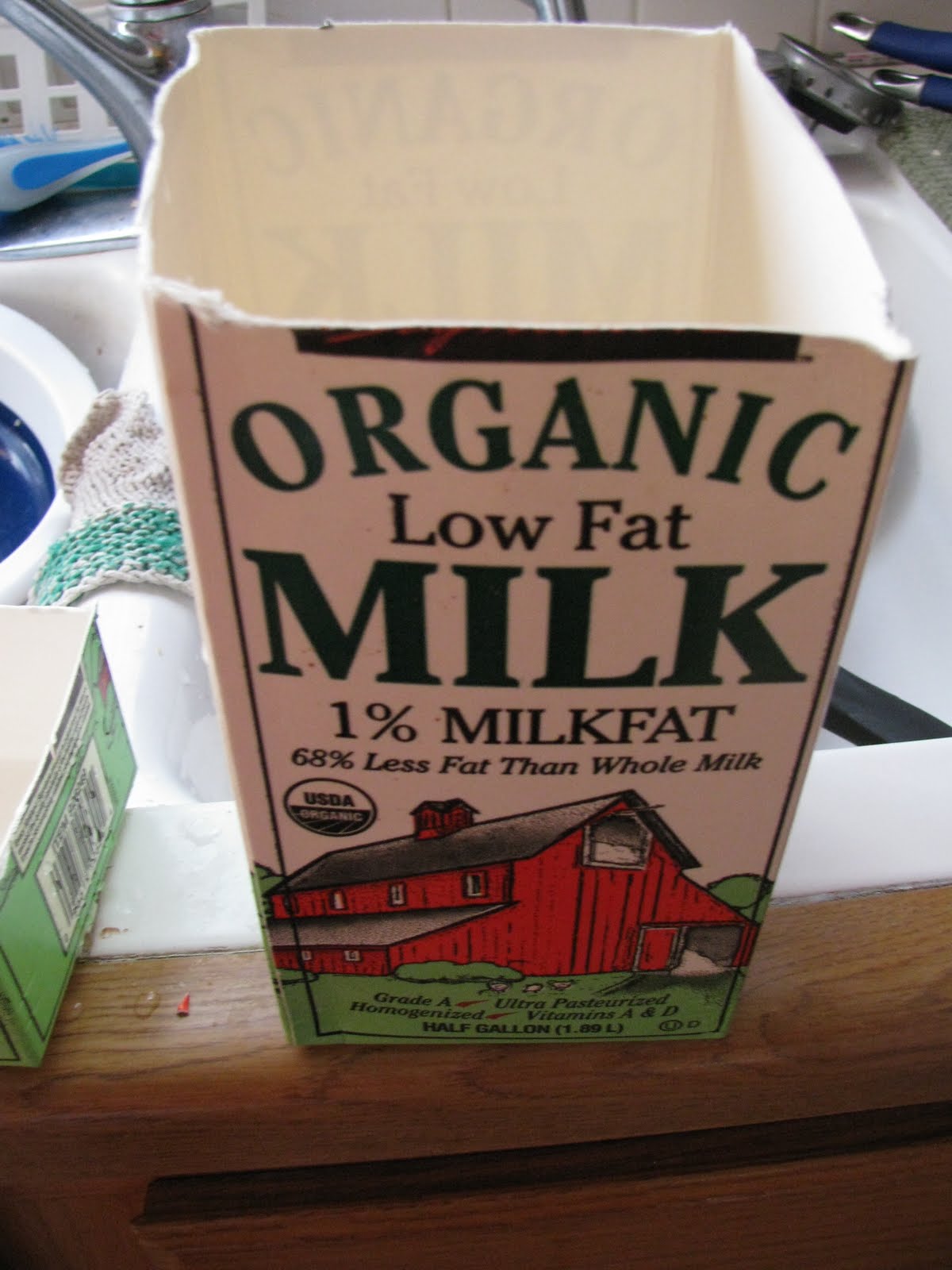
These are wicked inexpensive planters for those who want to garden but don't want to spend an absolute fortune on pots. I can't remember if I've shown these before, but here's a tutorial. It can also be used with water bottles, plastic milk jugs, sour cream containers... you name it, as long as at least the bottom half is waterproof.

Supplies:

2 matching waterproof containers, well washed (skip steps 1 and 2 for sour cream containers)
scissors and possible screw driver
tape (optional)
dirt/seeds/water

Step 1 - Cut the first carton 3" or so up from the bottom. It doesn't have to be exact, but try to keep the line fairly straight.


Step 2 - Cut the top off carton no. 2, keeping it as tall as possible. If using a milk jug, I'd suggest cutting off the handles.


Step 3 - Take carton no. 2 (the taller one) and punch 5-6 holes in the bottom with a screw driver or scissors.

Step 4 - Place carton no. 2 on the first carton. If the top carton is too big, make small slits in the sides of the bottom cartons. Here's the step where you can use tape if you really want to, but it usually isn't necessary.


Step 5 - Fill to 1/4" of the top with dirt/soil, get it moist and plant your seed according to the directions. Set outside and you've got yourself a wicked inexpensive planter that won't leak all over the place. They'll eventually (after several years) break down or compost or whatever, but that's ok, since it's easy to replace.

I've had great luck with these. Happy Spring, early Happy Earth Day and all that jazz!


P.S. I'm thinking of making the top of the carton where I just cut off the bottom into an upside down planter (plant sticking out the spout)... haven't gotten that far, and we'll see how it goes.

Wednesday, March 31, 2010

Working with Whey - My Oatmeal Dilemma

Several months ago, while discussing healthy foods with a friend, my friend mentioned that she uses her whey (leftover product from making cheese) in her oatmeal. Whey has protein in it, and probably other trace nutrients from milk. I decided to give it a go.

It sucked. I used only whey for my liquid, and the oatmeal tasted like a nasty acrid mush. My mouth still curls in disgust when I think of it. It makes my Dad's oatmeal taste nice. (cringe)

So, I have tried to make whey in oatmeal edible. I've used less of it, etc. No matter what I still taste a little of that acrid tang. I would recommend using it for no more than 1/3 of your oatmeal liquid.

In trying to doctor this up so my kids wouldn't turn their noses up at it, I discovered a nice little combo. Whey and nutmeg. Ground nutmeg helps cover most of the acrid aftertaste. I don't use a lot. Only a pinch. And if you like cinnamon, a small pinch (which goes a long way) is also very yummy.

Also of note, I have discovered there are two different kinds of whey (thank you wikipedia): sweet whey and acid whey. My whey is acid whey (it's leftover from making ricotta). Perhaps I'd have better results with sweet whey, but until I make a cheddar, swiss or rennet cheese, I'll just use nutmeg.

Any successful whey recipes any of ya'll use (including oatmeal)?

Tuesday, March 30, 2010

Where's the Idea Plumber?

So, my ideas are totally backed up. The only solution is an idea flush. That means I'll be posting 3-4 times a week for the next 2 weeks or so. Talk about crazy. It must be 'cause it's Spring.