Friday, August 7, 2009

Homemade Instruments

I just moved to a new area, and I've really missed the musical kids activities that a friend of mine organized. I wanted to do it in my new area, but I don't have that many instruments. A little web searching, creativity, friend brain picking later, and I have three kinds of instruments I'm making: shakers, drums, and wrist bells. I cannot guarantee non-toxicity, though I've done the best I know how. As long as the kids don't swallow a chunk of an instrument it should be fine.

Here are some pictures and a brief description of the first: the shakers. You need a cardboard tube (toilet paper, paper towel), stapler, filler (beans, popcorn, etc.), and duct tape. You can also paint if you'd like, though I suggest a sealer of some kind (silicon spray or decoupage work) to prevent it from coming off with sticky or sweaty little hands.


Here is a picture of a painted shaker (still not completely finished). I forgot to take pictures before I stapled them, but you should be able to see what you do. Staple one side of the cardboard tube. Put in some filler. Close the second opening perpendicular to the first one, and staple. If you want to paint (and seal), do it now. Here's an upclose of the staples:


After your paint/sealer is dry, cut strips of duct tape long enough to cover the staples. I suppose this isn't necessary, but I think it's really important if you want little kids to use them, cause the staples can snag clothes or cause little boo-boos. Here's a picture of one I finished a while ago, and also my 1 1/2 year old playing with it.

Yogurt Pics


Here are two pictures of the yogurt. Unfortunately, I accidentally forgot to put the yogurt in the fridge before going to bed, so the yogurt is a bit lumpy from "running" too long. The first one is plain, and the second one has some sweetened condensed milk in it, which gave it a slightly "sticky" consistency.

I didn't take a picture of it, but I used some of the sweetened condensed milk yogurt to make homemade yogurt popsicles... holy awesomeness batman. I especially like to break it onto pieces on top of a warm waffle with some lemon curd. Mmmmm. Or just by itself as a popsicle as a bedtime treat. I just added about 2T water for every 1/3-1/2C, and then put them in popsicle molds. I'm told you can also use toothpicks in an icecube tray if you don't have popsicle molds. Just be sure to cover them if you do that.

Saturday, August 1, 2009

Making Yogurt

While perusing my favorite blogs a while back, I found some information on making yogurt (see http://heavenlyhomemakers.com/blog/make-your-own-yogurt-and-cream-cheese). I checked it out, and, as usual, I got super excited. If my husband didn't keep me in check I would waste so much money on the things I get excited about (many of which I don't actually finish). I did "need" to buy some glass jars. Unfortunately, I've realized since then, if I'd been more patient, I could have just accumulated various glass jars to use. But, that's what I get for being impatient. So, here's a rundown of the super easy and inexpensive way to make your own yogurt!

Materials:
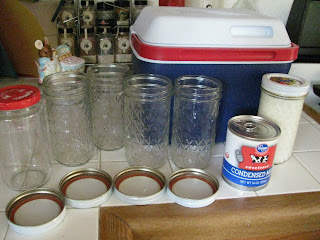
a cooler
sterilized GLASS jars (see notes)
food thermometer (candy, meat, whatever)
saucepan
any live culture plain yogurt
milk (raw or pasteurized; whole or 2%)
water, and a way to reheat it

optional - sweetened condensed milk, vanilla, other flavorings (I like to flavor with fruit syrup)


Directions:

1. Heat your milk in a saucepan (don't microwave; I think you could change important milk proteins). If it's older or your really concerned about bacteria, heat it to just boiling and then cool it. Just make sure the milk is about 120 degrees F (see note below). When you add room temperature stuff, the milk will decrease a bit in temp.


2. Add 2 heaping Tablespoons live culture yogurt in smaller jars, 1/2 Cup in larger jars. Add any other ingredients (mine below have sweetened condensed milk, and one has acai juice; always leave one plain so you can use it as your starter for the next batch).


3. Pour the warm milk in the jars until a bit below the rim. Please note that it is rather difficult to take a picture and pour milk at the same time, so don't try that unless you want a mess. Or use a funnel.


4. Stir really well with a fork or spoon. If you don't distribute the yogurt into the milk, your culture will be really slow going. Put lids on the jars.


5. Put warm water into the cooler. Be careful not to put in so much that they'll cover the top lid of the glass jar. Heat portions of the water until its 120 degrees F, or just under.


6. Put the jars in the cooler and close it on up. Check the water temp every hour or two. Try to keep the water temp about 120 degrees, 'cause it'll lose heat over time. I scoop out water with a mug, microwave it a minute, and then pour the water back in. I repeat until I get the water to the right temperature. However you keep the temp right is up to you.

7. Let it go for 8-12 hours; however long it takes for it to stay put when you tilt the jar. Then put it in the fridge to stop the process. Otherwise it curdles.


I don't have a picture of the finished product. I'll try to get one up soon. If you do plain yogurt, you can strain it with a cheese cloth to make yogurt cheese. Kind of like cream cheese but more tart. I like it with grated carrot, pimentos, and garlic salt. You can see instructions for that at the website I mentioned above.

I love my yogurt with honey and nutmeg, personally. I'm trying out the sweetened condensed milk mixed from the get-go on my mom's recommendation. Apparently when she was in college, they would make yogurt from sweetened condensed milk and put it on the space heater instead of in a cooler. I don't know if I can handle quite that much sugar, but it sounded yummy enough to try a smaller amount mixed with my milk. I hope anyone who tries it enjoys!


(Notes)

Glass Jars: They must be glass, from what I understand. I think it's probably because glass conducts heat better, plus there's no risk of any plastic toxin leaching into the yogurt. You can buy mason jars online or at a kitchen or grocery store. Or you can be really resourceful and save and clean your glass jars from jam, spaghetti sauce or whatever. I run mine through the dishwasher. The only ones I wouldn't recommend for this are pickle jars or other really strong smelling jars. Those need to air out forever before you can get the taste out of them.

Temperature: The bacteria that make yogurt thrive at 115 degrees F. They will grow between the temperatures of 98 and 125ish degrees F. Any higher than 125 (if I remember correctly), and they die. Any lower than 98, and they go dormant. Many sites suggest 90-110 degrees. I've found my yogurt takes forever at these temps. I get thicker yogurt at a median incubation of 115 degrees.

Friday, June 26, 2009

Spiced Carrot Oatmeal


I normally wouldn't post a recipe I wasn't totally in love with, but as it happens, my kids (ages 1 and 3) loved it. They kept spooning more out of my bowl into theirs. I ended up having to eat the dregs from the pot. I thought it was a little spice heavy and slightly sweet, so if you're not making it for kids, you may want to 1/2 the spices and sweetener.

Ingredients:

1 C liquid (I did 1/2 milk, 1/2 water)
3-4 T carrot juice
1/2 a small carrot, finely shredded
3 T sweetener (I did 2 T brown sugar, 1 T agave nectar)
1/2 t salt
large pinch ginger
large pinch nutmeg
1/2 t cinnamon
3/4 C rolled oats

note: you can use either carrot juice or shredded carrot if you just have/want one. I like to have both so the kids can't pick out the orange specs, plus I love carrot juice.

Mix all the ingredients except the oats in a saucepan. Make sure it tastes right for you before you add the oats. Bring to a boil. Add oats (whatever variety you like) and cook accordingly. For rolled oats, that's about 5 minutes. Cool slightly and serve with a dash of milk.

Tuesday, June 16, 2009

Easy Inexpensive Gardening Tips

Before I get to the crux of this post, I need to say that I tried to make a faux banana creme brulee oatmeal, and it tasted awful. Just in case you didn't know, an older banana (even small brown spots) should never be cooked for even a few minutes. It feels stringy and disgusting.


So, I started a garden this year. I wanted to share my three favorite successful ideas that I gleaned from other blogs or internet searches. I wish I could take credit, but I just didn't think of these things.

No. 1 Favorite Find - Newspaper Seed Planters!

These are free if you already get the paper, or you can use newspaper quality junkmail (like the grocery store ads we get). Also, they biodegrade, which means you can dig a hole and plunk the whole thing right in the ground, newspaper and all. Another thing I like is that I can tell when the plant needs to transplant: the roots start poking through the bottom of the newpaper. Google "newpaper seed planters" for instructions; there are several different varieties of ways. The only downside is it's not horribly attractive once the newpaper starts to look crisp and you do need some kind of drainage catcher. This is what my patio table has looked like for two months now:


No. 2 Favorite Find - Second Generation Green Onions


Whenever you use green onions, or really any onion, check the roots. Many times their are still one or two viable roots. For green onions, simply cut the white part within a 1/2" or less of the roots, and plant it so the top is covered by 1/4"-1/2" of dirt. In two to three months, you end up with green onions (like the ones to the right here). I'm curious to see exactly how many generations of green onion I can get. For regular onions, plant the root part that you cut off when you prep the onion. You can cut it in a bit of a cone (with the base being the roots) if that's easier. As far as I know (but I'm no expert), the tops of almost any edible onion are edible. I could be wrong, but at this point I simply don't know. If I die from eating an onion top, I'll let you know. :)


Favorite Find No. 3 - Recyclable Pots


These are milk jug planters. I found this idea online, but I can't remember where. You can use milk jugs, pop bottles, whatever. Poke/Cut holes in the bottom, and cut the tops off. They won't last more than a few seasons, but you should still be able to send them to the recycling center after you're done as long as their clean. Perhaps they aren't the prettiest, but I'm hoping to get colored masking tape to put along the top to see if I can make it look like ribbon and maybe paint come acrylic flowers. Or make contact paper stickers to put on. I'm using these for carrots, since my yard has really rocky soil (i.e. not carrot friendly).


For a tip on groing a great basil bush, see this blog page: http://mybyrdhouse.blogspot.com/search/label/Garden%20tips. Pruning has helped revive some of my most defeated Basil plants. A thought on gardening: Plants have survived millenia without people taking care of them. They're a lot stronger than we sometimes think, and often weaken an otherwise strong plant by overpampering.


I hope you enjoy the ideas! Sorry that it's a bit late in the season to share. But, for those of us in SoCal, use the ideas in the fall, when our real growing season starts. Here are a few pictures that mean a lot to me: the oregano I brought back from the almost dead; my first blue shelling pea flower; my first bush bean "fruit." Enjoy!

Friday, June 5, 2009

Plain Old Oatmeal, But Oh So Good!


So, here's Recipe #1, Plain old Oatmeal:

2 Cups Liquid (I do 1 C. milk and 1 C. water)
1 Cup Oats
3 T. Brown Sugar (or equivalent Sweetener)
1/4 - 1/2 t. Salt (or to taste)
optional 1/2 t. vanilla


Mix all ingredients in a small saucepan.
Bring to a boil.
Let simmer for 5 min. for quick oats (longer for steelcut or other varieties).
Serve warm with a dash of milk and any berry, banana, or other soft fruit.

I know, it sounds very difficult. ;)

Thursday, June 4, 2009

Sweeteners

Before I go posting any recipes or delicious pictures (or at least I hope delicious pictures) of oatmeal, I feel the need to wander into the world of sweeteners. I know there are multiple kinds of sweeteners out there, and I hope my recipes will be adaptable to most any of them.

In my kitchen, I have: granulated (white) sugar, brown sugar, pasteurized honey, agave nectar, and liquid stevia. I am going to give a brief run down on my feelings for each of these sweeteners in regards to oatmeal.

Granulated (white) sugar ~ I doubt I will ever use this in oatmeal. I feel like it tastes too empty for the robust texture of a good oatmeal. However, when in a pinch, it will work.

Brown Sugar ~ There's light and dark. I don't have a real preference yet. Brown sugar is my favorite for oatmeal at the moment, because it adds some depth that compliments the oats taste and texture.

Honey ~ Currently I only have pasteurized clover honey, but I hope to get some raw honey to experiment with. Different honeys have different tastes, so when in doubt leave the sweetener for last, pull out a small portion, and taste test. I also love honey for oatmeal, but the foretaste is too strong for certain recipes. In general, I will write it when I use honey, but don't hold me to that.

Agave Nectar ~ A great alternative to honey. The flavor isn't as heavy; great for lighter tasting oatmeal. I often combine this with stevia or honey because it's more expensive. Some people like it for the lower glycemic index; some don't because of the high fructose levels.

Stevia ~ You can get it in powder or liquid form. I have it in liquid form. You can find it in most health food stores with herbal supplements. It is not necessarily a supplement; it just isn't FDA approved to be sold as a regular food/sweetener. It also has a lower glycemic index. The only thing about stevia is that some people say it has a bitter aftertaste. For me it isn't necessarily bitter; more like my mouth feels a little dry. I use it to sweeten baking without adding more sugar that necessary. In things like oatmeal (or yogurt), I use it in combination with more rounded sweeteners (like brown sugar, honey, or sometimes agave nectar), as the aftertaste of those sweeteners helps mask the stevia aftertaste.